

The power of side-by-side connection: why men thrive in activity-based groups

Sometimes the easiest way to get men talking is to stop making talking the point. Put ten men who don't know each other in a room and tell them:
“Right. Talk.”
Then stand back and enjoy the atmosphere.
Someone will check his phone.
Someone will suddenly become fascinated by the carpet.
Someone will ask what everyone does for work.
And at least one man will be calculating how quickly he can leave without appearing rude.
Now give the same ten men something to do.
Walk somewhere.
Build something.
Cook.
Play pool.
Watch football.
Volunteer.
Give them a reason to be there that isn't simply:
“MAKE FRIENDS.”
The whole thing changes.
Conversation has somewhere to start.
Silence isn't a problem.
People move around.
Different conversations happen naturally.
Nobody has to perform.
That's the basic idea behind side-by-side connection.
And it's one of the principles behind MoMENtum.

What is side-by-side connection?
It means exactly what it sounds like.
Connection develops while people are doing something together.
Instead of sitting opposite somebody specifically to talk, you're alongside them doing something else.
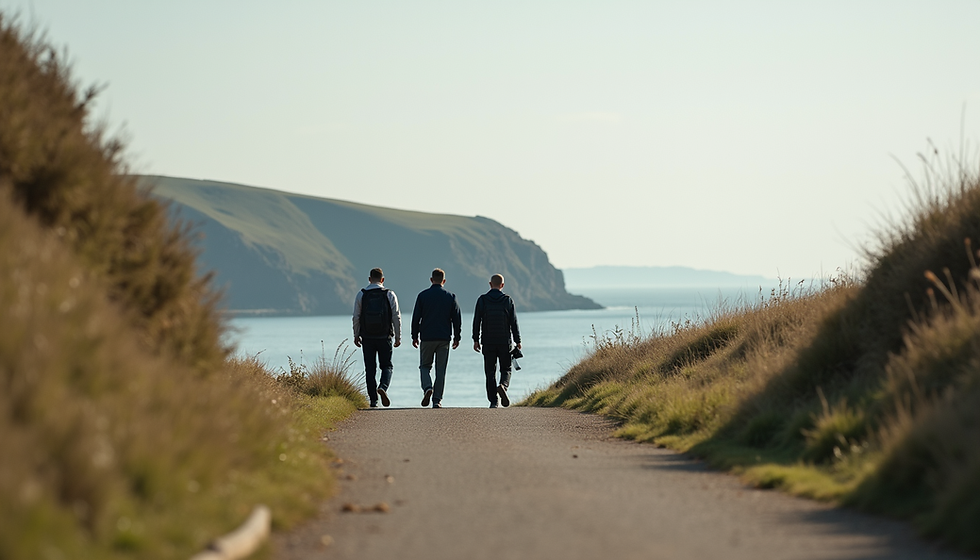
Walking is probably the simplest example.
You're looking ahead rather than constantly at each other.
Conversation can start.
Stop.
Change direction.
There can be silence without either person thinking:
“Bloody hell, this is awkward.”
The activity carries some of the social load.
That's useful when two people don't know each other particularly well.
Why shared activity matters
Think about your own friendships.
How many began because you deliberately went looking for a friend?
Probably not many.
More likely, you repeatedly did something around the same person.
You worked together.
Played football.
Went fishing.
Joined the gym.
Walked the dogs.
Went to the same pub.
Served together.
Volunteered.
Shared an interest.
The friendship developed around the activity.
This is so normal that we barely notice it.
Then adult life removes those activities and we wonder why making friends has suddenly become difficult.
Perhaps we don't need a revolutionary new method for male friendship.
Perhaps we need to recreate some of the conditions in which it used to happen.
What's actually going on?
Shared activity does several useful things simultaneously.
It gives you:
a reason to turn up;
something immediately in common;
something to talk about;
less pressure to maintain conversation;
an opportunity to see the same people repeatedly;
shared experiences that become future conversation.
That last part matters.
The first time you meet, you don't have any history.
After you've done something together, you do.
Even if the shared experience was simply getting soaked on a walk because somebody assured everyone:
“It definitely isn't going to rain.”
Next time, you've got something to refer back to.
That's how groups start developing their own stories.
And stories create familiarity.
Why men often connect through doing
We have to be careful with claims about how “men communicate”.
There are millions of men and we're obviously not all wired identically.
Some men love long conversations.
Some hate sport.
Some would rather have dental work than go fishing.
So this isn't:
Men are biologically designed to build sheds together.
But research into male friendships and community programmes repeatedly finds shared activity can be an important route into social connection for some men.
Men's Sheds are a particularly useful example.
Research into Shed programmes has found that the activity itself can provide purpose and routine while allowing conversation and relationships to develop informally alongside it.
The important part isn't woodworking.
It's the combination of:
activity + regularity + other people.
That's transferable to plenty of other settings.

The MoMENtum Activity Bridge™
I think shared activity works like a bridge.
On one side:
You.
On the other:
Someone you don't know.
Between you:
Something you're both doing.
So instead of:
You → STRANGER
you have:
You → ACTIVITY ← Other bloke
The activity gives you somewhere neutral to meet.
That's The Activity Bridge™.
Conversation doesn't need to appear from nowhere.
You've already got context.
“You been on this walk before?”
“Where are we going?”
“How far is it?”
“You live around here?”
And away you go.
Nobody had to announce:
“Let us now begin the friendship-building process.”
It happened because the environment allowed it.
Walking is particularly useful
There's a reason walking groups work well socially.
Walking is simple.
Most people understand it.
There's no requirement to be particularly good at it.
You can move between people.
Talk for five minutes.
Walk quietly.
Talk to somebody else.
There's also less direct social intensity than sitting across a table from a stranger.
And conversation changes while you're moving.
You notice something.
Someone tells a story.
A dog does something stupid.
The weather turns.
Something external keeps feeding the interaction.
That can make conversation feel considerably less forced.
Alan's perspective
This is one of the reasons MoMENtum has walks, coffee and meals rather than a room full of chairs.
I'm a therapist.
I spend a considerable amount of my working life sitting opposite people and talking.
It works.
That's therapy.
But I don't think every problem in life needs to be solved by recreating therapy outside the therapy room.
If a bloke says:
“I've lost touch with my mates and don't get out much,”
my first thought isn't automatically:
“We need to explore your emotional relationship with male intimacy.”
Sometimes we need to ask:
“When was the last time you regularly did something with other men?”
That's a different question.
And sometimes a much more useful one.
MoMENtum isn't trying to teach men how to socialise.
We're giving them somewhere to actually do it.
🔎 What I see at MoMENtum
Walking changes the dynamic.
People naturally break into twos and threes.
Then the formation changes.
You speak to one person.
Then somebody else.
Nobody needs to address the entire group.
And there's another advantage.
If you don't know what to say for thirty seconds, nothing happens.
You keep walking.
That sounds trivial.
It isn't.
Removing the obligation to constantly maintain conversation makes social contact much easier for people who are nervous, rusty or naturally quieter.
Coffee afterwards then feels different.
You've already spent an hour together.
You're not sitting down with complete strangers anymore.
You're sitting down with the men you've just walked with.
That's a subtle but important shift.
Shared experiences create social glue
Friendships aren't built entirely through exchanging information.
They're built through experiences.
Think about the stories you tell with old mates.
Remember when...
That holiday.
That night out.
That job.
That car.
That disaster.
That thing somebody said twenty years ago that is somehow still funny.
Those stories form part of the relationship.
New friendships don't have them yet.
So you need to create some.
That's another thing activities provide.
You aren't simply talking.
You're accumulating shared history.
Tiny pieces initially.
But enough of them eventually create:
“Remember last time...”
Now the relationship has continuity.

Why this can work better than networking
Networking has an objective.
Meet useful people.
Explain what you do.
Exchange details.
Perhaps create an opportunity.
That's fine if that's what you want.
But it creates performance.
You're presenting yourself.
Social connection works differently.
You don't need to be useful.
You don't need a pitch.
Nobody needs your LinkedIn profile.
You can simply be another bloke on a walk.
For men who spend much of their working life performing roles:
manager;
business owner;
professional;
dad;
husband;
provider;
that can be refreshing.
You don't have to achieve anything.
You don't need to be good at the activity
This is worth saying because competitive environments can create another barrier.
The activity is a vehicle.
Not an audition.
If a group is based around walking, the point isn't to identify Plymouth's greatest walker.
Nobody is handing out medals at Saltram.
The same applies to social activities generally.
You don't need to be:
the fastest;
strongest;
funniest;
most knowledgeable;
best golfer;
best cook.
If competition is enjoyable, fine.
But if the aim is connection, the activity should help people participate rather than establish another hierarchy.
Activities reduce the interview feeling
Meeting someone one-to-one for the first time can sometimes feel like a job interview.
Question.
Answer.
Your turn.
Question.
Answer.
Shared activity breaks that rhythm.
You can comment on what's happening.
Tell a story.
Pause.
Come back to something.
That allows personality to emerge more naturally.
And friendship depends on that.
You're not gathering facts about somebody.
You're discovering what they're like to be around.
The Side-by-Side Effect™
Think of social pressure as attention.
When conversation is the only activity, nearly all the attention is on:
you + me + what we're saying.
Add an activity and attention gets distributed:
you + me + walking + surroundings + other people + what's happening.
That's The Side-by-Side Effect™.
Less concentrated pressure.
More opportunities for natural interaction.
It doesn't guarantee friendship.
It simply creates a more forgiving environment for it.
Why repeated activity matters more than one brilliant event
Suppose you attend an amazing event.
Twenty great people.
Brilliant conversations.
Then you never see them again.
Socially, the value is limited.
Now imagine a fairly ordinary coffee group.
Same café.
Same Saturday.
Some of the same people.
Nothing spectacular.
But you attend six times.
By visit six:
you know names;
people know yours;
you know who's likely to come;
someone asks how your holiday went;
you continue a conversation from last month.
That's connection.
We sometimes chase novelty when what friendship really needs is repetition.
The bit nobody tells you: sometimes friendship is boring
I mean that positively.
Good friendship isn't always:
deep conversations;
big nights out;
amazing experiences.
Sometimes it's:
same café;
same people;
same terrible jokes;
another Sunday walk.
That's what makes it reliable.
The ordinary repetition is part of the value.
You know where you're going.
You know roughly who'll be there.
You don't have to manufacture a social life from scratch every weekend.
Why activity helps after separation or divorce
After a relationship ends, unstructured time can suddenly appear.
That isn't always a gift.
Saturday arrives.
No plans.
No family routine.
No obvious invitation.
Joining something activity-based gives the day structure.
You aren't walking into a room announcing:
“I'm recently divorced and need friends.”
You're going on a walk.
Your personal circumstances can remain private until you decide otherwise.
That makes the first step considerably smaller.
Why activity helps men working from home
If you work remotely, days can become extremely functional.
Laptop.
Emails.
Calls.
Lunch.
More laptop.
Finish.
There may be plenty of communication but surprisingly little human contact that isn't task-based.
A regular activity provides a different type of interaction.
Nobody needs anything from you professionally.
You're not discussing targets.
You're simply there.
That distinction can matter more than people realise.
Why activity can help retired men
Work often supplies structure and contact automatically.
Retirement removes both overnight.
A regular activity can replace some of that structure without pretending to replace the job.
Tuesday becomes:
“That's when I go there.”
Regularity creates rhythm.
And rhythm makes maintaining connection easier.
Do activities prevent serious conversations?
No.
Sometimes they make them easier.
You can walk beside somebody and say:
“Things have been a bit crap recently.”
without stopping everything.
The conversation can deepen naturally.
Or it can return to something lighter.
That flexibility is useful.
But serious conversation isn't the measure of whether the activity succeeded.
You might simply laugh for an hour.
That's still human connection.
⚠ Common misunderstanding: “Men need activities because they can't communicate”
No.
That's patronising.
Men communicate perfectly well.
The point is that different environments change how easy communication feels.
Activity can lower social pressure.
It can provide common ground.
It can make silence comfortable.
And it can create repeated contact.
Those benefits aren't evidence that men are emotionally defective.
They're evidence that context matters.
Activity is not a treatment
This distinction matters too.
Walking groups, sports clubs, Men's Sheds and social groups can support connection and wellbeing.
They aren't replacements for medical care or therapy where those are needed.
If someone is experiencing severe depression, significant anxiety, suicidal thoughts, addiction or another serious difficulty, joining an activity group may be useful alongside appropriate support.
But:
“Go for a walk with some blokes”
isn't a clinical treatment plan.
MoMENtum doesn't pretend otherwise.
How to use activity to build a social circle
If you're trying to meet people, look for five things.
1. Regularity
Does the activity happen repeatedly?
2. Interaction
Will you actually speak to people?
A cinema may involve other humans, but sitting silently in the dark isn't ideal for making friends.
3. Manageable size
Can you realistically become familiar with people?
4. Low barrier to entry
Do you need expensive equipment or specialist skills?
5. Something you don't hate
You don't need to discover your life's passion.
But you'll need enough interest to return.
That's the key.
Return.
🌱 One small step this week
Don't search:
“How do I make friends?”
Search for:
“What could I regularly do around other people?”
That's a better question.
Choose one.
Walking.
Volunteering.
Sport.
Coffee.
Hobby.
Men's group.
Whatever suits you.
Then give yourself a simple target:
Go twice.
The first visit tells you what the activity is like.
The second starts telling you what the people are like.
That's much more useful information.
Frequently asked questions
What is activity-based connection?
It is social connection that develops while people participate in a shared activity rather than meeting solely for conversation.
What does side-by-side connection mean?
It describes interaction that happens while people are alongside one another doing something, such as walking, working on a project or volunteering.
Why can activities make conversation easier?
They provide common ground, reduce pressure to maintain constant conversation, allow natural pauses and create external things to talk about.
Do men prefer activity-based friendships?
Some research suggests shared activities are particularly important in many men's friendships, but individual preferences vary substantially. It shouldn't be treated as a rule about all men.
What are Men's Sheds?
Men's Sheds are community spaces where people, predominantly men, meet around practical activities and social contact. Research has examined their potential contribution to connection, wellbeing and belonging.
Is walking good for making friends?
It can be. Walking is relatively low-pressure, allows conversation to start and stop naturally and can be repeated regularly. The friendship benefit comes from the social contact rather than walking magically creating relationships.
What activities are best for meeting people?
Activities that repeat, allow interaction and attract some of the same people each time tend to provide better opportunities for relationships to develop.
What if I'm not sporty?
You don't need sport. Walking, coffee groups, volunteering, hobbies, Men's Sheds, community groups, games and many other activities provide similar opportunities.
What if I'm shy?
Activities can help because conversation isn't the sole focus. You can participate first and gradually become more comfortable with people.
Do I have to talk about personal things?
No. Social connection can begin with ordinary conversation. More personal conversations may develop naturally as trust grows.
Is MoMENtum an activity group or a support group?
MoMENtum is primarily a men's social connection group. Activities such as walks, coffee and meals give men opportunities to meet and build relationships without the structure of group therapy.
Can I come to a MoMENtum activity alone?
Yes. You don't need an existing friend in the group. Creating opportunities for men to meet other men is part of the point.
The MoMENtum question
Think about the men you've been closest to during your life.
Then ask:
“What were we doing when that friendship developed?”
Working together?
Playing sport?
Going out?
Studying?
Serving together?
Building something?
Walking?
Going to matches?
There was probably a structure around the friendship.
You didn't necessarily create the relationship by sitting opposite each other and trying very hard to connect.
You shared enough life for connection to happen.
Then adulthood removed the structure.
Perhaps the answer isn't to become better at “making friends”.
Perhaps you need to put some structure back.
One regular walk.
One coffee.
One activity.
Somewhere you keep seeing the same people.
Nobody can guarantee who you'll connect with.
That's part of being human.
But you can dramatically increase the opportunity.
That's what we're trying to do at MoMENtum.
Create the bridge.
Give men a reason to cross it.
Then get out of the way and let ordinary human relationships develop.
Sometimes the conversation matters.
Sometimes the activity matters.
Often it's the combination.
If sitting around trying to make friends sounds awful, don't. Find something worth doing and see who you meet while you're doing it.


Comments